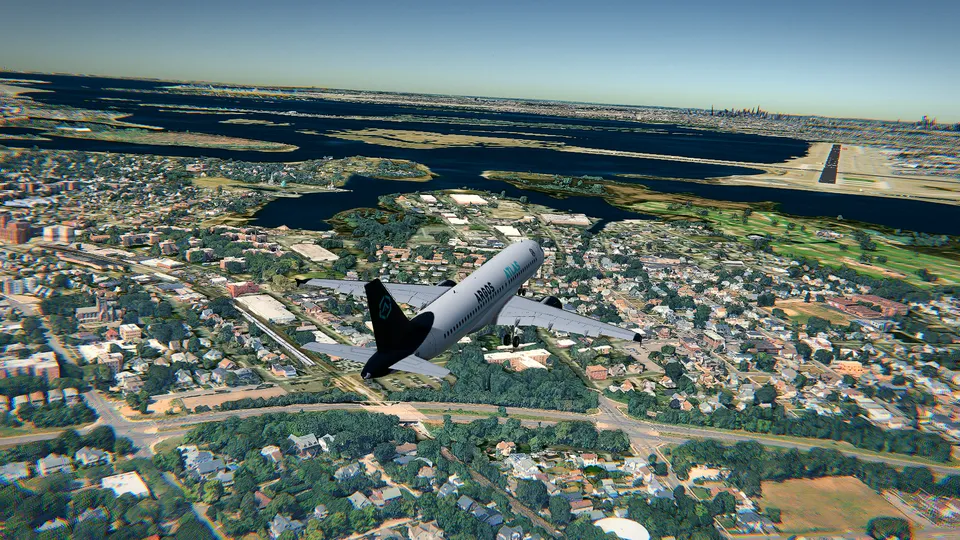
Kai Tak vs Hong Kong International: the story of the world's most famous approach
Why landing at Hong Kong's old Kai Tak airport was legendary, the checkerboard turn over Kowloon's rooftops, how Chek Lap Kok replaced it in 1998, and how to fly both places today in a flight simulator.
For more than seventy years, Hong Kong's airport sat in the middle of the city. Its runway pushed out into Victoria Harbour, mountains closed it in on three sides, and the most common approach ended in a low, tight turn over the rooftops of Kowloon, close enough for passengers to see into apartments. Pilots called it a challenge; photographers called it heaven. Then, on a single night in 1998, it all moved to a new airport built on an island. This is the story of both, and of how to fly them today.
Kai Tak: an airport in the city
Kai Tak began as an airfield in the 1920s on land reclaimed from Kowloon Bay, and grew with Hong Kong into one of the busiest airports in Asia. It never had room to grow sideways. Its single runway, 13/31, was extended again and again into the harbour on reclaimed land, until it reached about 3,400 metres, a finger of concrete with water on both sides.
The problem was not the runway. It was everything around it. To the north and east rose the hills of Kowloon and the New Territories, some of them over 500 metres high. To the west and south was a dense city of towers. There was simply no straight, clear path to one of the runway's ends.
The checkerboard turn
The approach that made Kai Tak famous was the one to runway 13, used when the wind blew from the southeast. Aircraft could not fly a long straight final towards it: the hills were in the way. Instead they followed an instrument guidance system that pointed them not at the runway, but at a hillside to the northwest of it.
On that hill was painted a large orange-and-white checkerboard. Pilots flew towards it, descending, until it filled the windshield. Then, at a few hundred feet above the ground and about two nautical miles from the runway, they made a visual right turn of roughly 47 degrees, banking low over the rooftops of Kowloon City, to line up with the runway just before touching down.
Everything happened close to the ground and late:
- The turn was flown by hand, by eye, often in gusty crosswinds coming off the hills.
- The aircraft rolled out of the turn on a very short final, with little time to correct.
- Below, streets and apartment blocks passed so close that the approach became a sight in itself.
Airlines trained their crews specially for it, and passengers who flew it never forgot it. Among pilots it earned a nickname, the Kai Tak heart attack.
Why Hong Kong needed a new airport
By the 1990s Kai Tak was working far beyond what it had been designed for, with a single runway, noise over a dense city and no room left to expand. Night flights were restricted because of the people living around it. Hong Kong needed a new airport, and it found the space where there was none: in the sea.
Chek Lap Kok: an airport built on an island
The new Hong Kong International Airport was built on a huge platform reclaimed around two small islands, Chek Lap Kok and Lam Chau, off the north coast of Lantau. Hills were flattened and the sea was filled to make room for runways long and straight enough for any aircraft, approached over open water.
It opened on 6 July 1998. Kai Tak closed the same night: the equipment, vehicles and aircraft that could be moved went across in a single overnight operation, and the next morning flights were landing on the island.
Since then the airport has kept growing. It opened with one runway, added a second soon after, and in the 2020s a third, built on more reclaimed land to the north. Today it has three parallel runways, 07L/25R, 07C/25C and 07R/25L, and it is one of the busiest cargo airports in the world.
Two airports, two kinds of approach
| Kai Tak (closed 1998) | Hong Kong International (VHHH) | |
|---|---|---|
| Location | Kowloon Bay, in the city | Reclaimed island off Lantau |
| Runways | One, 13/31 | Three parallel runways |
| Approach | Curving, low, visual turn for runway 13 | Long, straight approaches over the water |
| Terrain | Hills close on three sides | Lantau's mountains to the south |
| What pilots remember | The checkerboard and the rooftops | The view of the islands and peaks |
Approaching Hong Kong International is calmer than Kai Tak ever was, but it is still beautiful. From the west you come in low over the water of the Pearl River estuary; to the south, Lantau Peak rises over 900 metres, and on a clear day you can see the towers of Kowloon and Hong Kong Island in the distance.
Flying it in Open Flight World
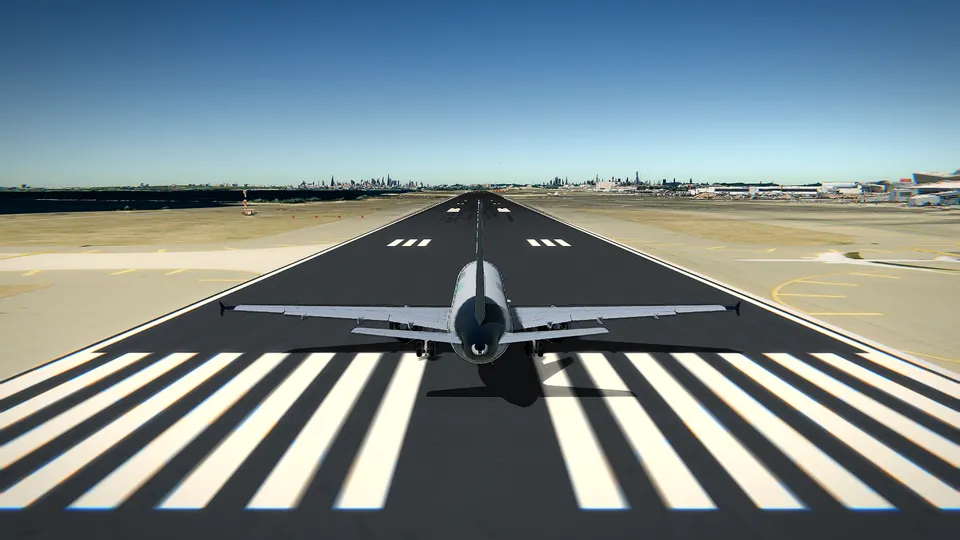
Hong Kong International is the free airport in Open Flight World, with the Cessna 172. That makes it a perfect place to start, and a perfect excuse for a history flight.
- Open the simulator, choose the Cessna 172 and Hong Kong International (VHHH).
- Take off and head east. The old Kai Tak site is about 28 km (15 nautical miles) away, across the north of Lantau and the harbour.
- Fly over Victoria Harbour at a couple of thousand feet. Kai Tak's old runway is still there as a long peninsula pointing into the bay, with a cruise terminal at its tip and a new district built over the rest.
- Look north from there to the hills that made the approach so hard, and imagine flying a 747 into that turn.
- Fly back west and land at VHHH, where the approach is long, straight and over the water. If you need a refresher, read how to land a Cessna 172.
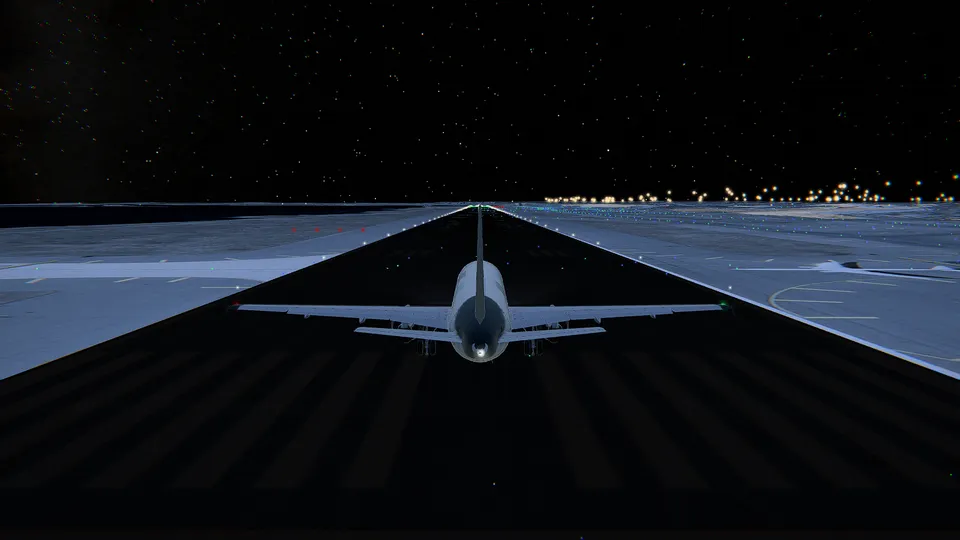
With the HD graphics, Hong Kong's towers are drawn with Google's photorealistic 3D buildings and, by day, they count as obstacles: fly into one and the flight ends. Try it at dusk, when the city lights come on and the harbour turns gold, and at night, when the runway lights of VHHH guide you home.
Why Kai Tak still matters
Kai Tak is remembered because it asked pilots to fly the old way, by hand and by eye, in one of the busiest airports in the world, until the very last day. Its replacement shows the other side of aviation: when a city needs safer skies, it builds them, even if it has to make the land first. Flying both, the history and the present, is one of the best reasons to open a flight simulator over Hong Kong.
For more places worth flying, see the sixteen best airports to fly in a simulator.
Frequently asked questions
Why was Kai Tak so difficult?
Because the usual approach to its runway 13 could not be flown straight in. Pilots followed a guidance beam towards a hill with a checkerboard painted on it, then made a low right turn of about 47 degrees over the rooftops of Kowloon to line up with the runway at the last moment.
When did Kai Tak close?
On 6 July 1998, when Hong Kong International Airport at Chek Lap Kok opened. The move between the two airports was made overnight.
Can I fly to Kai Tak in Open Flight World?
Kai Tak is no longer an airport, but you can fly over where it was. Hong Kong International (VHHH) is free in Open Flight World, and the old Kai Tak site in Kowloon is about 28 km to the east.